


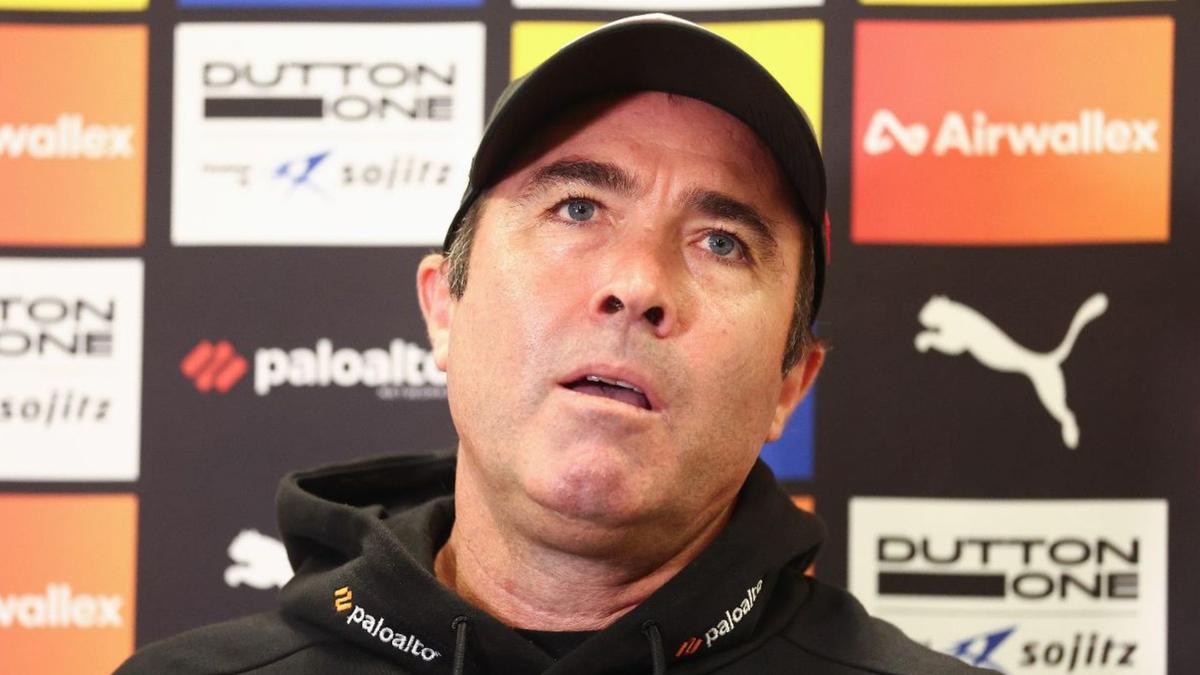

Questions are suddenly being asked around Essendon’s “soft cap” management after it has come to light that the embattled club will pay out sacked coach Brad Scott in full this year.
The revelation comes after CEO Tim Roberts confirmed last week that the club could manage the financial impact of Scott’s departure, despite widespread concerns about soft cap pressures at Essendon, and across the competition.
WATCH THE VIDEO ABOVE: Essendon’s Brad Scott payout under scrutiny
Know the news with the 7NEWS app: Download today
Scott, who was thought to be earning between $800,000 and $1 million annually, will receive the payment for the remainder of this season which, importantly for Essendon’s next coach, means it won’t impact the soft cap in 2027.
“And the AFL have agreed that all that money will go into their soft cap this year,” veteran journalist Caroline Wilson said on Channel 7’s The Agenda Setters.
However, questions have been raised about how a struggling Essendon could have such a significant amount available in their soft cap (the money clubs can spend on their football department operations, including coaches, list managers, and fitness staff), when other clubs are reporting severe financial constraints.
AFL great Luke Hodge said it was impossible to fathom how Essendon could have “a spare million dollars” to pay Scott’s salary into this year’s soft cap.
“Did they go with less staff (this year)?” asked Hodge, while Collingwood premiership hero Dale Thomas asked, “Who are they paying there?”
AFL expert Kane Cornes said Essendon needed to explain themselves.
“If they have $800,000 spare at a struggling club, which could be (spent on) two development coaches, it could be a masseuse, it could be another doctor … with their injury list …. what are they doing? How could it not be spent?” Cornes asked.
“Now, I might be overreacting here, but I think at least the Bombers need to explain to their supporters how there could be, when clubs are screaming about how tight this is, how assistant coaches are underpaid, a spare $800,000 to $1 million that they can just hand a cheque to Brad Scott for doing nothing?”
The club has not confirmed whether welfare boss Ben Robbins and assistant coach Ben Jacobs, who both departed following Scott’s sacking, have been paid out for the remainder of the year.
If they resigned of their own volition, they may not be entitled to payouts.
“So there’s a chance that they are not getting paid at all because, of course, they quit,” Wilson said.
“Now, my gut feeling is that Essendon might have looked after them. I’m not 100 per cent sure. I don’t know. But remember, Andrew Dillon has made significant changes to the soft cap in the last two or three years. It has gone up, and it has gone up quite significantly.”
But Cornes said Jacobs would not be “getting paid a lot” and Robbins would not be on big dollars either.
But Wilson said it made sense Essendon had room in the soft cap given they could not lure Ken Hinkley to the club for a director of coaching role, and experienced assistant Daniel Giansiracusa left at the end of the 2025 season and joined Hawthorn.
“They weren’t able to replace him, really, with someone of his senior assistant coaching pedigree, so there are savings right there,” Wilson said.
“They looked at bringing in another senior football person. That didn’t happen. Has there been a deal done behind the scenes with the AFL? No one is admitting that, and maybe that’s happened, but I’m not sure the AFL would be super keen on that happening, although they clearly want to try and help Essendon get up again.
“All I’m saying is, next year, there is plenty of money to bring in someone like John Longmire, and I believe he is very much on that club’s radar, and the rest is history.”
The arrangement with Scott differs significantly from Sydney’s situation when Longmire resigned at the end of last season.
The Swans were forced to include some of Longmire’s payment in the following year’s soft cap, leaving them with a threadbare assistant coaching group of just three coaches.


